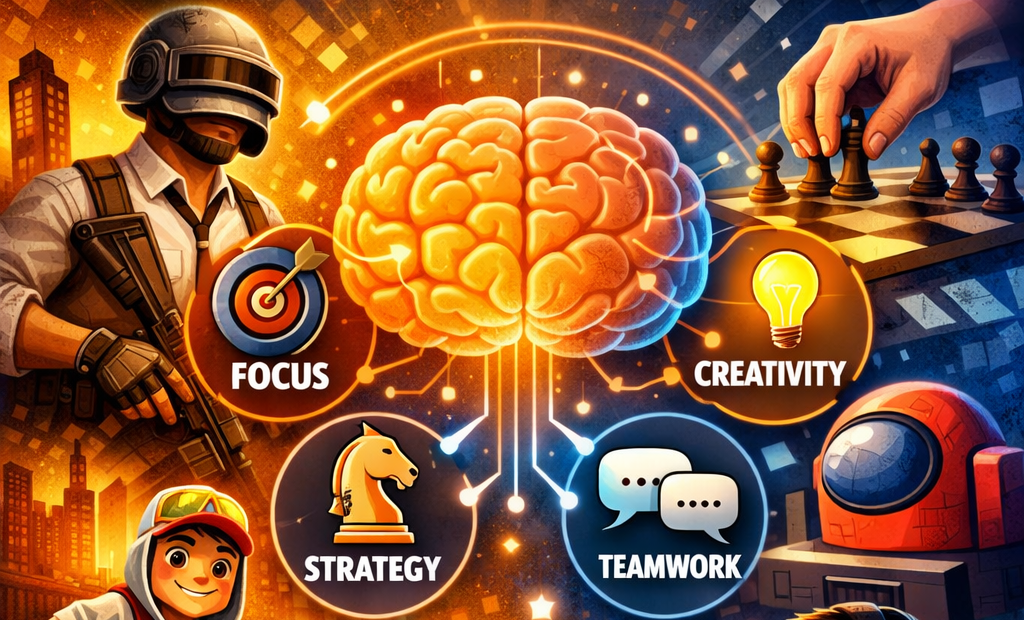
For years, video games have been blamed for poor academic performance, lack of focus, and wasted time. Parents worry, teachers complain, and society often labels gamers as unproductive. But this perception is slowly changing. Today, psychologists, educators, and even employers are beginning to recognize an important truth: not all games are harmful. In fact, many popular games are quietly training the brain with skills that directly translate into real-life success.
Gaming, when done in moderation and with the right mindset, can improve decision-making, creativity, focus, communication, and strategic thinking. These are not just “gaming skills” — they are life skills.
This article explores how certain games are secretly shaping smarter minds and how players can turn gaming into a powerful learning tool.
🎯 PUBG & Free Fire – Mastering Decisions Under Pressure
Battle royale games like PUBG and Free Fire place players in intense, fast-paced environments. The game constantly forces players to make split-second decisions: whether to fight or retreat, help a teammate or secure personal survival, rush forward or play defensively.
Brain Skills Developed:
-
Rapid decision-making
-
Stress management
-
Teamwork and coordination
-
Situational awareness
These games train the brain to process information quickly while remaining calm. Players learn that panic leads to mistakes, while controlled thinking leads to survival.
Real-Life Benefits:
In real life, pressure situations are unavoidable — exams, job interviews, workplace deadlines, emergency decisions, and leadership challenges. Gamers who regularly play battle royale games often develop the ability to think clearly under stress, a skill highly valued in professional environments.
🧱 Minecraft – A Digital School for Creativity and Innovation
Minecraft may look like a simple block-based game, but it is one of the most powerful creativity tools ever created. Players must gather resources, plan structures, solve problems, and manage time efficiently.
There are no strict rules in Minecraft — success depends on imagination and strategy.
Brain Skills Developed:
-
Creative thinking
-
Logical problem-solving
-
Planning and organization
-
Resource management
Minecraft encourages players to experiment, fail, rebuild, and improve — a mindset essential for innovation.
Real-Life Benefits:
These skills are directly applicable to careers in architecture, engineering, programming, game development, digital design, and entrepreneurship. Many educators now use Minecraft in classrooms to teach STEM concepts, proving that gaming can be educational when used correctly.
https://play.11winners.pro/games-that-are-secretly-training-your-brain/
🚆 Subway Surfers – Training Focus and Mental Endurance
At first glance, Subway Surfers seems like a casual endless runner game. However, surviving for long periods requires intense focus, fast reflexes, and consistency.
One small distraction ends the run.
Brain Skills Developed:
-
Concentration
-
Hand-eye coordination
-
Reaction speed
-
Mental endurance
The longer you play, the more your brain adapts to processing information quickly while staying alert.
Real-Life Benefits:
Students benefit from improved attention spans during study sessions, while professionals experience better accuracy and speed in task-oriented work. This type of focus is essential in fields like data entry, graphic design, gaming development, and even driving.
♟️ Online Chess – Building Strategic Thinkers
Chess is one of the oldest and most respected strategy games in the world. Unlike fast-paced action games, chess trains the brain to slow down and think deeply.
Every move has consequences.
Brain Skills Developed:
-
Strategic thinking
-
Patience and discipline
-
Logical reasoning
-
Risk assessment
Chess players learn to analyze multiple outcomes before making decisions — a skill that requires mental maturity.
Real-Life Benefits:
Strategic thinking is essential in business, finance, management, law, and leadership roles. Chess teaches players how to plan long-term, accept losses, and learn from mistakes — qualities that define successful professionals.
🕵️ Among Us – Social Intelligence and Communication
Among Us may appear cartoonish, but it is a powerful social deduction game that revolves around trust, deception, and communication. Players must analyze behavior, listen carefully, and express themselves clearly.
Brain Skills Developed:
-
Communication skills
-
Psychological analysis
-
Critical thinking
-
Observation and attention to detail
Players learn how words, tone, and timing affect group decisions.
Real-Life Benefits:
These skills are essential in teamwork, negotiations, sales, interviews, leadership, and conflict resolution. Understanding human behavior is one of the most valuable skills in both personal and professional life.
🧠 How Gaming Rewires the Brain
Scientific studies suggest that certain games enhance neuroplasticity, the brain’s ability to adapt and improve. Action games improve reaction speed, strategy games enhance memory, and social games boost emotional intelligence.
Gaming also encourages:
-
Goal setting
-
Persistence after failure
-
Learning through experimentation
These qualities are closely linked to personal growth and success.
⚖️ Smart Gaming: Turning Fun into Growth
While gaming has clear benefits, excessive and uncontrolled gaming can lead to addiction, reduced productivity, and poor health. The key difference between harmful gaming and beneficial gaming is control.
Smart Gaming Tips:
-
Set clear daily or weekly limits
-
Complete responsibilities before gaming
-
Choose games that stimulate thinking
-
Take regular breaks
-
Balance gaming with exercise and sleep
Gaming should support your life, not replace it.
https://www.apa.org/monitor/2014/02/video-game
🎓 Gaming and the Future of Education
The future of education is shifting toward gamification. Learning platforms now use game mechanics to increase engagement and motivation. From language apps to coding simulators, games are becoming a serious educational tool.
Gamers already possess a learning advantage — they are familiar with digital problem-solving, adaptability, and interactive learning.
🌟 Final Thoughts
Video games are no longer just entertainment. When played wisely, they can become powerful tools for brain development, creativity, and real-life success. The problem is not gaming itself — the problem is how and how much we play.
Instead of asking whether games are good or bad, we should ask:
Are we using games to escape life, or to prepare for it?
With balance, awareness, and smart choices, gaming can transform from a distraction into a skill-building advantage.