💡 Introduction
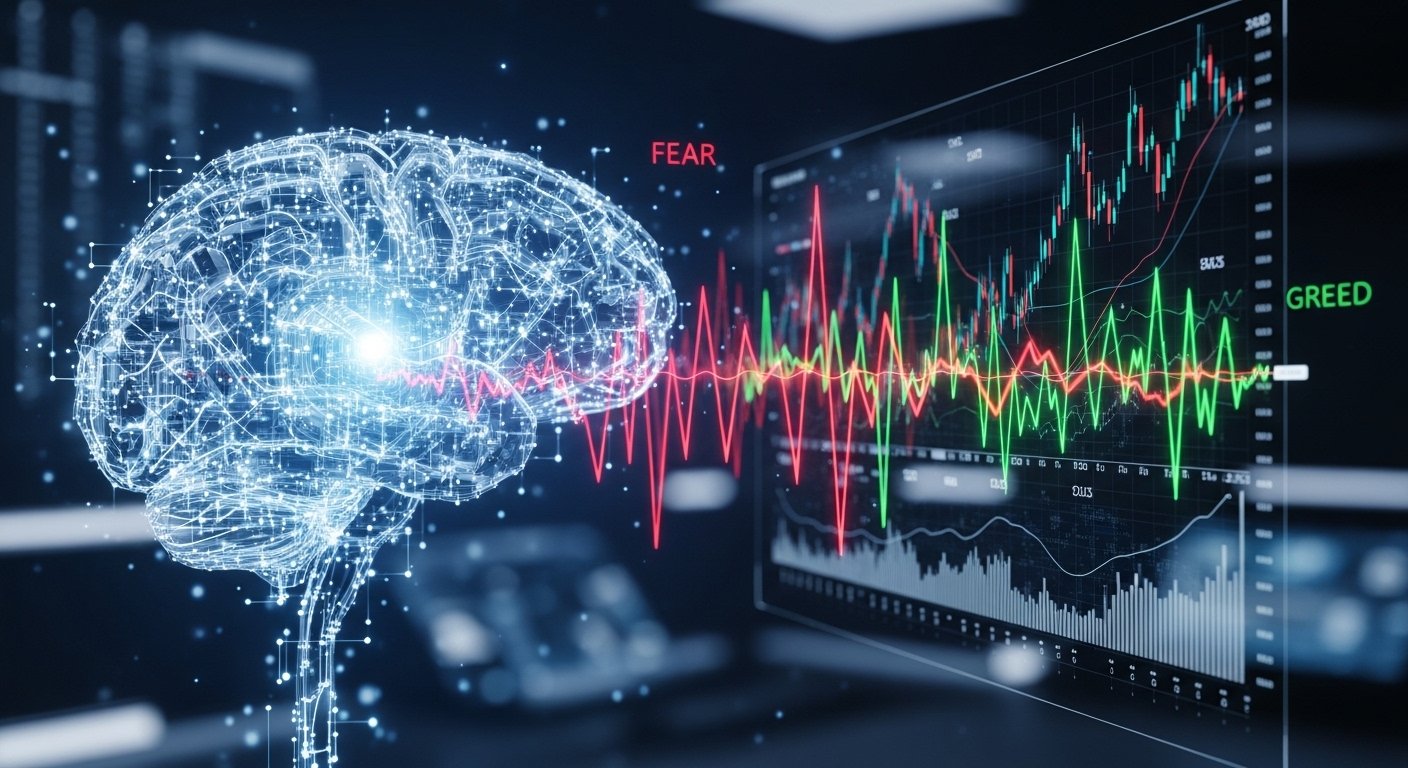
The stock market is often described as a battlefield of emotions. For decades, human traders have been driven by two powerful forces—fear and greed. These emotions influence buying, selling, and investment decisions, often leading to unpredictable market movements.
However, in today’s digital era, Artificial Intelligence (AI) is changing how markets operate. Advanced systems are no longer just analyzing numbers—they are learning human behavior itself. AI is now capable of understanding emotional patterns in trading, making it one of the most powerful tools in modern finance.
Companies like JPMorgan Chase, Goldman Sachs, and BlackRock are actively using AI systems to study market psychology and improve trading decisions.
🧠 Understanding Market Psychology
Market psychology refers to the collective emotions and behavior of investors that influence financial markets. Instead of being purely logical, markets often react based on:
- Fear of losing money
- Excitement during rising prices
- Panic during market crashes
- Overconfidence during bull markets
These emotional reactions create patterns that experienced traders try to understand and predict.
Traditionally, human analysts studied these behaviors manually. Today, AI systems are doing it faster, more accurately, and at a much larger scale.
🤖 How AI Learns Human Fear and Greed
AI systems use machine learning and data analysis to study human behavior in financial markets. They collect data from:
- Stock price movements
- Trading volumes
- News headlines
- Social media discussions
- Investor sentiment reports
By analyzing this information, AI can detect emotional trends in the market.
For example:
- Sudden selling pressure may indicate fear
- Rapid buying activity may indicate greed
- Mixed signals may indicate market uncertainty
Over time, AI models become better at recognizing these emotional patterns and predicting future market behavior.
https://play.11winners.pro/the-psychology-of-ai-trading-how-machines/
📊 Sentiment Analysis in AI Trading
One of the most powerful tools in AI trading is sentiment analysis. This technology allows machines to analyze human emotions expressed in text, such as news articles and social media posts.
If financial news is mostly positive, AI may predict rising market confidence. If the news is negative or fearful, AI may anticipate a market decline.
Companies like Bloomberg use advanced data systems to provide real-time financial sentiment insights to traders and institutions.
This ability to measure emotions at scale gives AI a major advantage over traditional trading methods.
📉 Fear vs Greed in Market Cycles
Markets typically move in emotional cycles:
🔴 Fear Phase
- Investors panic
- Prices fall
- Selling increases
- Market uncertainty grows
🟢 Greed Phase
- Investors become overconfident
- Prices rise quickly
- Risk-taking increases
- Market bubbles may form
AI systems are trained to recognize these cycles early. By identifying emotional shifts, AI can help traders make more rational decisions.
📈 AI in High-Frequency Trading
High-frequency trading (HFT) uses AI algorithms to execute thousands of trades in milliseconds. These systems not only analyze data but also react to emotional market shifts instantly.
Companies like Goldman Sachs and BlackRock use AI-powered trading systems to optimize investment timing and reduce emotional bias.
Unlike humans, AI does not panic or get greedy. It follows data-driven logic, which gives it a significant advantage in fast-moving markets.
🧬 Can AI Truly Understand Human Emotion?
While AI does not “feel” emotions like humans, it can interpret patterns that represent emotional behavior. By analyzing millions of data points, AI builds a model of how fear and greed affect market decisions.
However, there are limitations:
- AI cannot predict unexpected global events
- Emotional behavior can change suddenly
- Human psychology is complex and not always logical
Despite these challenges, AI continues to improve as more data becomes available.
⚠️ Risks of Emotion-Based AI Trading
Even though AI is powerful, it is not perfect. Some risks include:
📉 Over-Reliance on Data
AI depends on historical data, which may not always predict future events.
⚡ Market Black Swans
Unexpected events like wars or economic crashes can disrupt AI predictions.
🧠 Algorithm Bias
If training data is biased, AI decisions may also be biased.
🔄 Over-Automation
Too much reliance on AI can reduce human oversight in financial decisions.
🚀 The Future of AI in Market Psychology
The future of trading will likely be a combination of human intelligence and AI systems. Instead of replacing humans, AI will assist traders by providing deeper insights into emotional market behavior.
Future developments may include:
- AI systems that detect global emotional trends in real time
- Advanced predictive models for market crashes
- Personalized trading assistants for investors
- Fully automated emotional risk analysis systems
Financial institutions like JPMorgan Chase and BlackRock are already investing heavily in these technologies.
https://www.nasdaq.com/articles
🧾 Conclusion
The psychology of trading is no longer limited to human intuition. Artificial Intelligence is now capable of analyzing fear, greed, and emotional behavior in financial markets with remarkable accuracy.
While humans remain important for decision-making, AI is becoming a powerful tool that enhances understanding of market psychology. As technology evolves, the combination of human judgment and machine intelligence will define the future of global investing.
The financial world is entering a new era—one where emotions are not just felt, but also measured, analyzed, and predicted by machines.